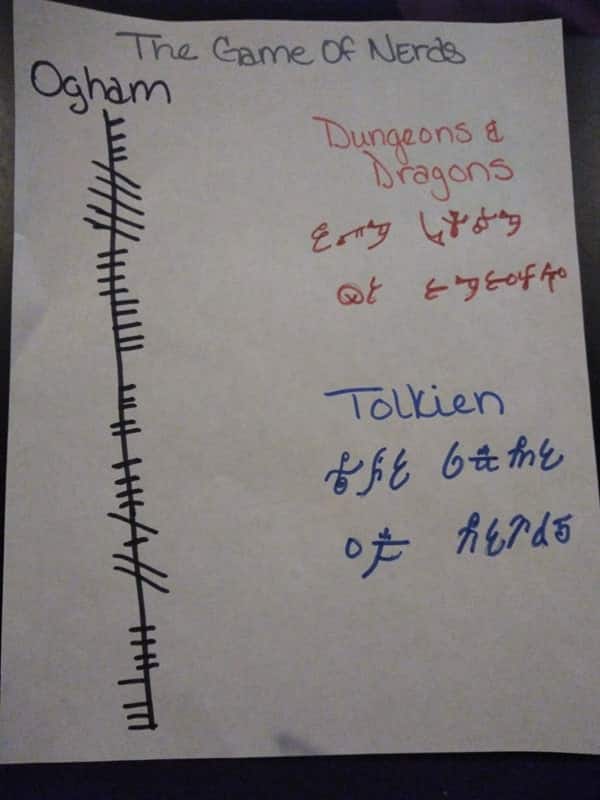
There is a specific kind of magic that happens when a fictional world stops using English with funny words sprinkled in and commits to giving its characters an actual, complete language: real grammar, real syntax, real cultural logic baked into every word. These are called conlangs, short for constructed languages, and the people who build them are doing something genuinely rare in entertainment: creating an entire linguistic system from scratch, one that has to sound consistent, feel culturally authentic, and hold up to obsessive fan scrutiny for decades.
Some of these languages were built by novelists working alone for the sheer joy of it. Others were built by professional linguists hired specifically because a producer decided a fictional culture deserved more than gibberish. Here are the most famous fictional languages ever created, and the people behind them.
Elvish (Quenya and Sindarin) — J.R.R. Tolkien
If there is a founding father of the modern conlang, it is J.R.R. Tolkien, a philologist and Oxford English Dictionary contributor who famously admitted that his real, driving passion was inventing languages, calling it his “secret vice.” In a letter, Tolkien wrote plainly that the stories of Middle-earth were created to provide a world for the languages, not the other way around. That is a genuinely rare thing for an author to admit: the entire Lord of the Rings mythology exists, in Tolkien’s own telling, largely because he wanted somewhere for his languages to live.
Tolkien did not stop at one Elvish language. He built an entire family of them, most notably Quenya, the more formal, ceremonial tongue of the High Elves, drawing heavily on Finnish, Latin, and Greek, and Sindarin, the everyday language of the Grey Elves, built from a Welsh-inspired sound and structure. Beyond Elvish, Tolkien also constructed Khuzdul for the Dwarves and rough sketches of Orkish, ultimately conceiving of roughly fourteen distinct languages across his body of work. The Elvish family alone now contains a documented vocabulary exceeding 100,000 words across fan-maintained dictionaries, and university courses exist specifically to study Quenya and Sindarin’s grammar. Tolkien is regularly called the godfather of modern conlanging, and virtually every fictional language that came after his work owes something to the standard he set.
Klingon — Marc Okrand
Klingon first appeared as a handful of grunted lines in the original Star Trek series, but it became a genuine, fully realized language when linguist Marc Okrand was brought on to develop it properly for 1984’s Star Trek III: The Search for Spock. Okrand built Klingon to sound, quite deliberately, harsh, guttural, and aggressive, mirroring the warrior culture of the species speaking it, and the result became arguably the most famous fictional language ever created.
The scale of Klingon’s real-world adoption is genuinely remarkable. Fans have translated both Shakespeare’s Hamlet and portions of the Bible into Klingon. The Klingon Language Institute has operated for decades with members worldwide, offering serious linguistic study of the language. People have used Klingon vows in real weddings. Colleges have offered actual credit-bearing courses in it. Okrand later went on to create Atlantean for Disney’s Atlantis: The Lost Empire, but Klingon remains his defining work, and the standard-bearer for what a fictional language can become once fans decide to actually adopt it.
Dothraki and Valyrian — David J. Peterson
George R.R. Martin included only a handful of Dothraki words scattered throughout his A Song of Ice and Fire novels, and was famously candid about how thin his own conlang work went, telling fans at one point, “I have something like eight words of Valyrian. When I need a ninth, I’ll make one up.” When HBO began adapting the books for Game of Thrones, producers realized they needed something far more substantial for the screen, and reached out to the Language Creation Society, which held an internal competition among its members to find the right person for the job. Linguist David J. Peterson won that competition and, using Martin’s handful of existing words as his foundation, built out a complete language from scratch.
Dothraki now contains roughly 4,000 functional words, drawing inspiration from Turkish, Russian, Estonian, Arabic, Inuktitut, and Swahili, giving it a genuinely distinct, nomadic-warrior-culture sound that matched the horse lords speaking it. Peterson also built out High Valyrian for the same series, deliberately modeling it after Latin: an old, classical, once-imperial language that has calcified into something spoken mainly in formal, scholarly, or aristocratic settings by the time the story takes place. The Economist once described Dothraki and Valyrian as the most convincing fictional tongues since Elvish, and in 2012 alone, 146 newborn girls in the United States were named Khaleesi, the Dothraki title for a ruler’s wife, entirely because of the show’s cultural reach.
Peterson has since become the most prolific working conlanger in the industry, having built more than fifty constructed languages across his career, including Shiväisith for Thor: The Dark World, Chakobsa for Dune, Trigedasleng for The 100, and languages for Shadow and Bone, Doctor Strange, and The Witcher, among many others.
Na’vi — Paul Frommer
When James Cameron set out to build the alien world of Pandora for 2009’s Avatar, he wanted the Na’vi people to speak something that sounded genuinely otherworldly rather than a thinly disguised human language. Cameron brought in linguist Paul Frommer, who built Na’vi with distinctly non-human phonetics and grammar, designed specifically so it would not accidentally resemble any single real-world language family too closely.
Na’vi’s cultural footprint has proven durable well beyond the first film. As Avatar’s sequels have continued rolling out, the language has grown alongside them, and enough people have taken up learning it seriously that linguistics researchers have studied Na’vi speakers’ brain activity, alongside speakers of Klingon, Dothraki, and High Valyrian, to better understand what genuinely makes something register as a real, complete language to the human brain rather than simple memorized code.
Simlish — Will Wright and Maxis
Not every fictional language is built for warriors or elves. Simlish, the cheerful, nonsensical-sounding language spoken throughout The Sims franchise, was deliberately designed to be understood emotionally rather than literally. Players never get subtitles. Instead, Simlish communicates entirely through tone, rhythm, and the accompanying animation, letting players intuit what their Sims are feeling without ever needing an actual translation. It is a completely different approach to conlang design than Tolkien’s or Peterson’s meticulous grammar systems, built for universal emotional accessibility rather than linguistic completeness, and it has proven so effective that real musicians, including Katy Perry and The Beach Boys, have recorded actual songs translated into Simlish for the games.
Huttese — Ben Burtt
When Jabba the Hutt needed to speak in the Star Wars saga, sound designer Ben Burtt built Huttese by working backward from Quechua and other real-world languages, twisting the phonetics into something alien while retaining an underlying, learnable linguistic logic. Huttese represents an interesting middle ground in conlang history: not as fully fleshed out as Klingon or Dothraki, but far more considered than the improvised gibberish that populated much of earlier science fiction. Burtt’s sound design work across the Star Wars saga, including Chewbacca’s vocalizations and R2-D2’s beeps, helped establish an entire aesthetic language for how alien communication could feel genuinely alien without needing full grammatical completeness.
Nadsat — Anthony Burgess
Not every entry on this list is a fully constructed language with its own grammar. Anthony Burgess’s Nadsat, the teenage slang spoken throughout A Clockwork Orange, is something more specific: a blend of English and Russian vocabulary, mixed with Cockney rhyming slang and pure invention, designed to give Burgess’s dystopian teenagers a voice that felt genuinely alien to adult readers while still being decipherable with effort. Burgess, a genuine polyglot with real linguistic training, built Nadsat specifically to age-proof the novel’s slang: by using invented and foreign-derived words instead of period-specific real slang, the language would not immediately date itself the way a story reliant on actual 1960s teen slang inevitably would. It remains one of literature’s most influential examples of a conlang used for characterization and cultural commentary rather than worldbuilding spectacle.
Chakobsa — David J. Peterson (for Dune)
When Denis Villeneuve set out to adapt Frank Herbert’s Dune for the screen, David Peterson returned to expand Chakobsa, the language of the Fremen people native to the desert planet Arrakis. Because Herbert’s original novels draw heavily on real-world Middle Eastern and North African linguistic and cultural influences, Peterson built Chakobsa with genuine ties to Arabic, giving the Fremen’s language a specific cultural weight that echoes the book’s own real-world inspirations. Dune: Part One featured only limited Fremen dialogue, but Dune: Part Two expanded the language considerably, giving Peterson room to build out a much fuller linguistic system for Arrakis’s native people.
Why These Languages Matter So Much to Fans
The best fictional languages accomplish something that a hundred pages of worldbuilding exposition never quite manages: they make a fictional culture feel real by giving it an actual voice. As Peterson himself has put it, writing a culture’s themes and values directly into a language’s grammar and idioms happens naturally once you commit to building a real linguistic system, because the language itself becomes a repository of everything that culture cares about.
That is why fans keep learning these languages decades after their films and shows first aired. Speaking Klingon at a convention, learning Dothraki vocabulary through a dedicated app, translating poetry into Quenya: all of it is a way of stepping further inside a fictional world than passive viewing ever allows. A constructed language is not a gimmick. Done well, it is one of the most immersive storytelling tools fiction has ever produced, and the linguists behind these languages have built something that, in scientific studies, genuinely registers in the human brain the same way a real, living language does.
Which fictional language do you wish you could speak fluently? Drop it in the comments.
Discover more from The Game of Nerds
Subscribe to get the latest posts sent to your email.